The African Penguins of Boulders Beach
Two pairs settled on a suburban beach in 1982. A census in June 2026 counted 790 breeding pairs. The species they belong to is now the first penguin in the world listed as Critically Endangered. What follows is what is on the sand when you arrive, and why the number changes so much through the year.
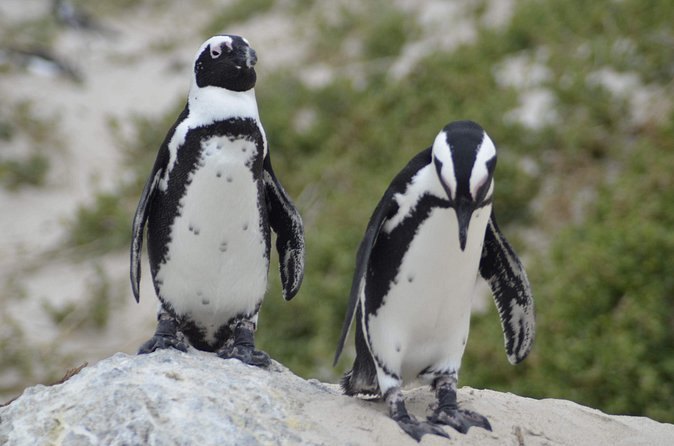
A colony that started with two pairs in 1982
African penguins bred on offshore islands for as long as anyone recorded them, not on the mainland, where caracals and domestic dogs reach them. Two pairs settled among the granite at Boulders in 1982, at a moment when commercial purse-seine fishing had emptied much of the inshore sea their island colonies depended on. The beach was sheltered, the boulders broke the swell, and the birds stayed.
What followed is the reason this is a national park section rather than a suburb with an unusual problem. The colony grew and the beach was fenced. A boardwalk went up over the dunes, and the birds now nest a few metres from a walkway that carries a thousand people a day without anybody stepping into a burrow.
790 breeding pairs, counted in June 2026
The colony is counted annually. SANParks walked the site in June 2026 with the Department of Forestry, Fisheries and the Environment, the City of Cape Town, the Cumic Rangers, SANCCOB and a group of volunteers. The result was announced on 25 June.
| Year | Count | What it means |
|---|---|---|
| 1982 | 2 breeding pairs | The colony is founded on a suburban beach |
| 2025 | 698 breeding pairs | The count before the most recent one |
| 2026 | 790 breeding pairs | About 2,528 birds, 8–9% of South Africa's total |
Ninety-two more pairs than the year before is a rise, and against the species' trajectory it is a notable one. SANParks called the site a key breeding colony for a critically endangered species. That is a careful way of saying a beach beside a naval town now carries close to a tenth of the country's African penguins.
Critically Endangered since October 2024
On 28 October 2024 the International Union for Conservation of Nature moved the African penguin from Endangered to Critically Endangered. It is the first of the world's eighteen penguin species to reach that category. At the assessment about 19,800 mature birds remained in the wild, roughly 9,900 breeding pairs split between South Africa and Namibia. That is a loss of something close to 97 per cent of the historical population.
The causes are at sea rather than on land. Sardine and anchovy stocks have shifted away from the colonies that depend on them, and a bird that cannot fly cannot follow them far. Nothing you do on the boardwalk changes that. The conservation fee you pay at the gate goes to the park that protects this colony.
What the birds are doing when you arrive
The single most useful thing to know before booking a date is that the colony is not the same size every month. The birds spend part of the year at sea.
February to August — breeding
The busiest months on the sand. Pairs are on nests among the scrub and under the boulders, chicks appear through the season, and adults come and go from the water all day.
September and October — at sea
Adults leave to feed heavily before they moult. Some birds remain, but this is the emptiest the beach gets, and a visitor who books these weeks blind is often surprised.
November and December — the moult
Each bird replaces every feather at once. For about three weeks it cannot swim or feed and simply stands in the dunes, looking bedraggled. Plenty of birds, very little movement.
January — juveniles and recovery
Young birds moult into adult plumage while the adults feed up for the coming breeding season. A mixed month, and a good one.
Which month suits which visitor is set out in full on the best time to visit, alongside the gate hours and the crowds.
Why a suburban beach at all
Boulders works for penguins for the same reasons it works for swimmers. The granite breaks the swell, so chicks are not washed out of nests. The scrub behind the dunes gives burrowing cover. False Bay is shallow and productive enough to feed a colony without a long crossing, and the birds found a beach that did the job an island used to do.
The cost is proximity. Penguins cross roads in Simon's Town, nest under decks and occasionally walk into gardens. The town has adapted around them with speed bumps, fencing and a good deal of patience.
Watching them without harming them
- Stay on the boardwalk. The walkway exists so that nobody stands on a burrow; the nests are in the scrub either side of it.
- Keep two metres from any bird on a path. They walk the same routes people do between the cove and the colony, and they have right of way.
- Never touch or feed one. It is not permitted anywhere in the reserve, and a fed bird stops fishing.
- Keep food packed away. Gulls follow an open packet straight to the nests.
- Leave the dog at home. Dogs are not allowed in this section, and they are one of the reasons a mainland colony is unusual.
See the colony with a guide who knows the season
Guided days reach the boardwalk at the hour it is quietest, and several of them cover the conservation fee at the gate.
Frequently asked about the penguins
How many penguins are there at Boulders Beach?
What is the penguin moult, and does it matter?
Why were there no penguins when I visited in October?
Do African penguins bite?
Why is the African penguin called a jackass penguin?
What is the pink patch above the eye?
Sources
- SANParks: the June 2026 census, 790 breeding pairs against 698, and the share of the national population.
- BirdLife South Africa: the October 2024 uplisting and the global population at assessment.
- Boulders Beach: the 1982 colonisation and the age of the granite.
Counts are announced annually; verify the current figure before quoting it.
Plan the visit on hours, fees and access. Work out which gate to use on where Boulders Beach is, then compare every fare on Boulders Beach Tours.